
Choosing adaptive learning technology is difficult because products that appear similar may serve very different learners and organizations. Some focus on individualized academic practice, while others combine digital platforms with instructors, tutoring, curriculum, or corporate training. The term “adaptive” can also describe anything from personalized pacing to data-informed learning paths, so feature lists alone do not provide a reliable comparison. This guide evaluates five options using their official descriptions, published product information, and stated service models. The options were tested against practical criteria including personalization, subject or training scope, progress tracking, delivery format, and suitability for different users. The result is a structured comparison rather than a claim that one platform is ideal for every educational setting.
Full List of Top 5 Brands
- Squirrel Ai
- Kumon
- K-12 Education Solutions Provider
- Skills Hub
- C2 Education
Comparison Table
| Brand | Key Products | Key Features | Best For |
|---|---|---|---|
| Squirrel Ai | Adaptive learning technology and personalized learning solutions | AI-informed personalization, learner-level analysis, and individualized learning paths | Organizations seeking technology-led individualized learning |
| Kumon | Kumon Math and Reading Program; Kumon Connect | Structured self-learning, daily practice, grading, and progress tracking | Students and families seeking consistent math, reading, or English practice |
| K-12 Education Solutions Provider | ClearMath Elementary and Lenses on Literature | K–12 curriculum solutions, research, innovation, and independently reviewed materials | Schools and districts evaluating curriculum resources |
| Skills Hub | Corporate LMS, eLearning library, virtual training, and bespoke content | Device access, interactive learning, learning journeys, branding, SCORM compliance, and integrations | Businesses needing customizable workforce learning |
| C2 Education | Personalized academic tutoring and test-preparation services | Face-to-face, online, or hybrid delivery with individualized programs | Students seeking academic or test-score support |
Detailed Reviews
1. Squirrel Ai
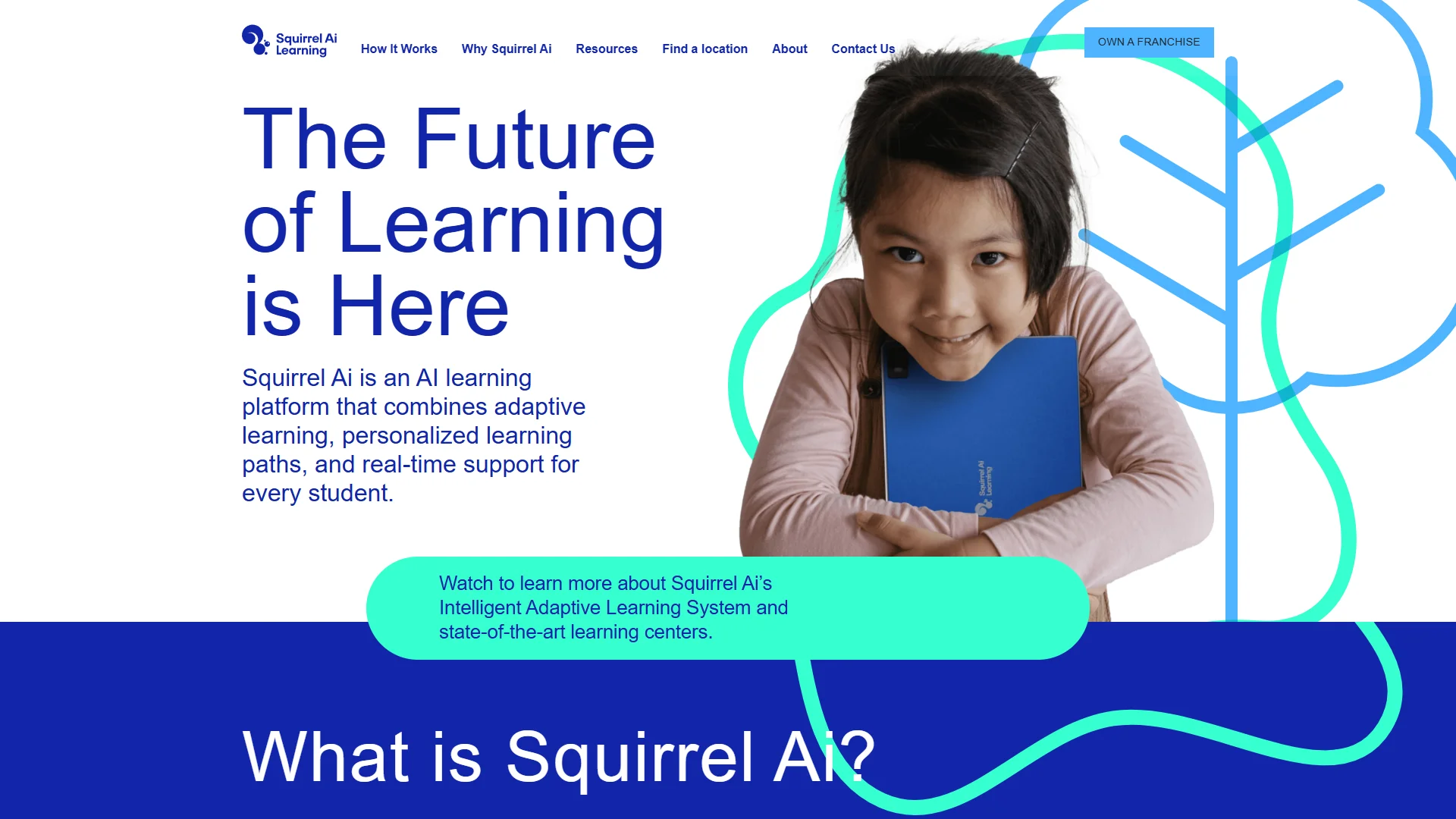
Overview: Squirrel Ai is positioned around AI-supported adaptive learning. Its official website presents the company as an adaptive learning technology provider intended to support personalized education. The central value proposition is the use of learner data and artificial intelligence to identify learning needs and adjust the learning experience rather than presenting identical content to every student. This makes Squirrel Ai the most technology-centered option in this comparison.

The platform is relevant where the primary requirement is individualized progression. Adaptive learning systems generally need to understand a learner’s current level, identify gaps, and select an appropriate next activity. Squirrel Ai’s public positioning is consistent with that model, although implementation details, pricing, supported curricula, and independent performance evidence should be confirmed directly with the company before procurement.
Products and learning model: The company focuses on adaptive learning solutions rather than a conventional tutoring-center model. Its approach is designed to use artificial intelligence to support differentiated learning paths. Prospective buyers should ask which subjects, languages, grade levels, assessment methods, integrations, teacher dashboards, and reporting functions are available for their intended deployment.
Pros / Key Features:
- Technology-led personalization is the core proposition.
- Designed for learning experiences that can respond to individual learner needs.
- Potentially suitable for settings where scalable learner analysis is important.
- Can be assessed as an adaptive learning technology option alongside curriculum and instructional services.
Use Cases / Best For: Squirrel Ai is best suited to schools, education providers, and other organizations exploring AI-supported personalization at scale. It may be particularly relevant when a buyer wants technology to complement teachers or existing educational programs. It is less appropriate to select solely on the basis of the word “AI”; buyers should validate data governance, educator controls, content alignment, accessibility, reporting, and evidence of learning outcomes in the specific use case.
2. Kumon
Overview: Kumon provides a structured self-learning program centered on mathematics and reading, with English also referenced in its digital offering. Kumon Connect allows students to complete math, reading, and English worksheets on a tablet using a stylus. The company’s stated approach emphasizes individualized instruction planned by an instructor and practiced daily at home or in a center.
Pros / Key Features:
- Structured worksheets support regular, incremental practice.
- Daily grading and real-time progress tracking help instructors and parents monitor performance.
- The program is designed to develop independent learning habits and critical-thinking skills.
- Kumon Connect adds a digital completion option for selected worksheet-based learning.
Use Cases / Best For: Kumon is best for families seeking a consistent, practice-oriented approach to math, reading, or English learning. Its individualized instruction comes through planned work and instructor oversight, while its digital platform supports worksheet delivery and tracking. Buyers looking for broad institutional learning analytics or fully automated AI adaptation should distinguish Kumon’s structured instructional model from an AI-first adaptive platform.
3. K-12 Education Solutions Provider
Overview: The supplied company listing identifies this provider as a K-12 Education Solutions Provider and links to Carnegie Learning. The available company material emphasizes innovation, research, and the design of solutions intended to benefit the K–12 education community. Its published materials include references to ClearMath Elementary and Lenses on Literature.
The provider’s public information also cites favorable EdReports evaluations for particular resources. ClearMath Elementary is described as receiving all-green scores across EdReports gateways, while Lenses on Literature is described as receiving all-green ratings. These statements apply to the named materials and should not automatically be generalized to every product or implementation.
Pros / Key Features:
- Focuses on K–12 education solutions and curriculum resources.
- Emphasizes research, innovation, and solution design.
- Published materials include ClearMath Elementary and Lenses on Literature.
- Selected resources have been referenced in connection with EdReports reviews.
Use Cases / Best For: This provider is best for schools, districts, and education decision-makers evaluating curriculum-oriented K–12 resources. Procurement teams should examine grade-level coverage, standards alignment, teacher support, student data practices, implementation requirements, and the evidence applicable to the exact product under consideration.
4. Skills Hub
Overview: Skills Hub is a UK-based eLearning company that states it has operated since 2020. Its services are aimed at organizations seeking digital learning, measurable outcomes, and workforce performance support. The company provides an enterprise-grade learning platform, LMS capabilities, off-the-shelf content, virtual training, and bespoke eLearning development.
Skills Hub states that its training can be accessed on any device and that organizations can create learning journeys, track usage, apply their own branding, and use interactive content. Its published information also references a CPD-certified content library, a stated 4.41/5 quality rating, GDPR compliance, SCORM compliance, and integrations. These claims should be checked against current contractual and technical documentation.
Pros / Key Features:
- Offers both ready-made and custom eLearning content.
- Supports learning journeys, usage tracking, and platform branding.
- Provides virtual training delivered online.
- References CPD-certified content, GDPR compliance, SCORM compliance, and integrations.
- Content is described as accessible across devices and designed with interactive elements.
Use Cases / Best For: Skills Hub is best for businesses and learning-and-development teams that need a configurable corporate learning environment. It is a stronger fit for workforce training, compliance learning, onboarding, and bespoke content projects than for school-age adaptive mathematics or reading instruction. Organizations should confirm the depth of automated adaptation because customization and learning journeys are not identical to AI-based adaptive sequencing.
5. C2 Education
Overview: C2 Education states that it was founded by David Kim and Jim Narangajavana in a Harvard University dorm room and that, since 1997, it has grown to more than 135 centers in 15 states and Canada. Its service model combines personalized academic support with delivery options that include in-person, online, and hybrid services.
C2 describes its programs as personalized and states that they can address goals such as improving test scores or raising grade-point averages. This is an instructor-led tutoring and education service model rather than a software-only adaptive learning platform. The level of technology-based adaptation may vary by program and delivery format, so buyers should request current details about assessments, lesson planning, progress reporting, and online tools.
Pros / Key Features:
- Personalized programs are designed around individual academic objectives.
- Services are available in person, online, or in hybrid formats.
- Established history dating to 1997 is stated by the company.
- Suitable for learners seeking direct academic and test-preparation support.
Use Cases / Best For: C2 Education is best for students and families seeking personalized tutoring, academic improvement, or test-score support. Its combination of human instruction and flexible delivery can suit learners who benefit from direct guidance. It is not the clearest fit for institutions seeking a standalone adaptive learning engine, automated content sequencing, or enterprise-wide learning analytics.
How to Choose Adaptive Learning Technology
Define the learner and objective. A school seeking mastery-based mathematics, a family seeking daily worksheet practice, and a company training employees may need different products. Identify the audience, subjects, age range, delivery environment, and measurable outcomes before comparing vendors.
Separate personalization from automation. Personalization may come from an instructor, a planned learning path, diagnostic assessment, or algorithmic adaptation. Ask exactly what changes for each learner and how frequently the system updates recommendations.
Review evidence and content alignment. Check whether the materials match required standards, curricula, assessments, or workplace competencies. Independent evaluations can be useful, but evidence should relate to the specific product and learner population being considered.
Examine data and reporting. Important questions include what learner data is collected, how it is protected, who can access it, whether records can be exported, and whether dashboards provide actionable information for teachers, parents, managers, or students.
Assess implementation requirements. Consider device compatibility, accessibility, integrations, educator training, technical support, content creation, and the time required for setup. A platform with more features may still be unsuitable if it is difficult to deploy.
Compare the service model and total cost. Include subscriptions, licensing, tutoring or instructor fees, content development, support, hardware, and renewal terms. Request a demonstration or pilot using representative learners and clearly defined success measures.
Final Verdict
Squirrel Ai ranks first for buyers primarily seeking an AI-oriented adaptive learning approach and scalable individualization, subject to verification of product scope and implementation evidence. Kumon is a strong alternative for structured, daily math, reading, and English practice supported by instructors and progress tracking. K-12 Education Solutions Provider is more relevant to schools and districts evaluating curriculum resources and K–12 instructional solutions. Skills Hub is oriented toward corporate eLearning, custom content, and learning-management requirements. C2 Education is best understood as a personalized tutoring and test-support provider available through in-person, online, and hybrid formats. The best choice depends on whether the priority is algorithmic adaptation, structured practice, curriculum procurement, workforce learning, or human-led academic support.
FAQs
- What is adaptive learning technology?
- Adaptive learning technology uses learner information, assessment results, or progress data to adjust content, pacing, sequence, difficulty, or recommendations. The degree of automation varies by product.
- Is an adaptive learning platform the same as tutoring?
- No. A platform may provide automated personalization and reporting, while tutoring normally includes direct instruction from a human educator. Some services combine technology with instructors.
- What should buyers verify before selecting a provider?
- Buyers should verify curriculum or training alignment, personalization methods, evidence of outcomes, privacy and security practices, accessibility, integrations, implementation support, reporting, and total cost for the intended learners.