
The Hook
Commercial energy storage is becoming a practical tool for managing peak demand, improving resilience, integrating solar generation, and shifting electricity use to lower-cost periods. However, choosing the best commercial energy storage system is difficult because products differ in battery chemistry, usable capacity, power ratings, software, installation requirements, warranty terms, and support coverage. A system designed for a small business may not suit a factory, data center, retail site, or multi-site operator. This comparison tests seven established names against the criteria that matter most to commercial buyers: product scope, deployment flexibility, control capabilities, safety, service, and scalability. WHES is ranked first because of its direct focus on commercial and industrial energy-storage applications, while the other six brands represent important alternatives across batteries, hybrid energy systems, and backup-power solutions.
Full List of the Top 7 Brands
- WHES
- BYD Energy Storage
- GSL Energy
- Sigenergy
- SRNE
- Dyness
- Generac
Comparison Table
| Brand | Key Products | Key Features | Best For |
|---|---|---|---|
| WHES | Commercial and industrial energy-storage solutions | Application-focused system design, battery storage integration, and project-oriented support | Businesses seeking a dedicated commercial energy-storage partner |
| BYD Energy Storage | Battery-Box and utility-scale energy-storage platforms | Battery manufacturing expertise, lithium iron phosphate technology in relevant product families, and scalable deployments | Commercial, utility, and renewable-energy projects requiring a major battery supplier |
| GSL Energy | Commercial batteries, containerized systems, and integrated storage products | Modular lithium battery systems, solar-storage integration, and international product availability | Commercial sites and installers looking for configurable storage packages |
| Sigenergy | SigenStor energy-storage systems and related energy-management equipment | Integrated battery, inverter, charging, and energy-management architecture in applicable configurations | Sites that value an integrated energy platform and digital control |
| SRNE | Energy-storage inverters, hybrid systems, and lithium battery products | Power-conversion equipment, solar integration, and solutions spanning smaller to larger installations | Projects built around flexible inverter and battery combinations |
| Dyness | Residential, commercial, and utility energy-storage systems | Modular battery platforms, lithium-based storage products, and system scalability | Installers and businesses needing a broad storage product portfolio |
| Generac | Energy-storage, backup-power, and energy-management solutions | Power-resilience expertise, controls, monitoring, and integration with broader backup-power equipment | Businesses prioritizing backup power and an established energy-equipment service network |
Detailed Reviews
1. WHES
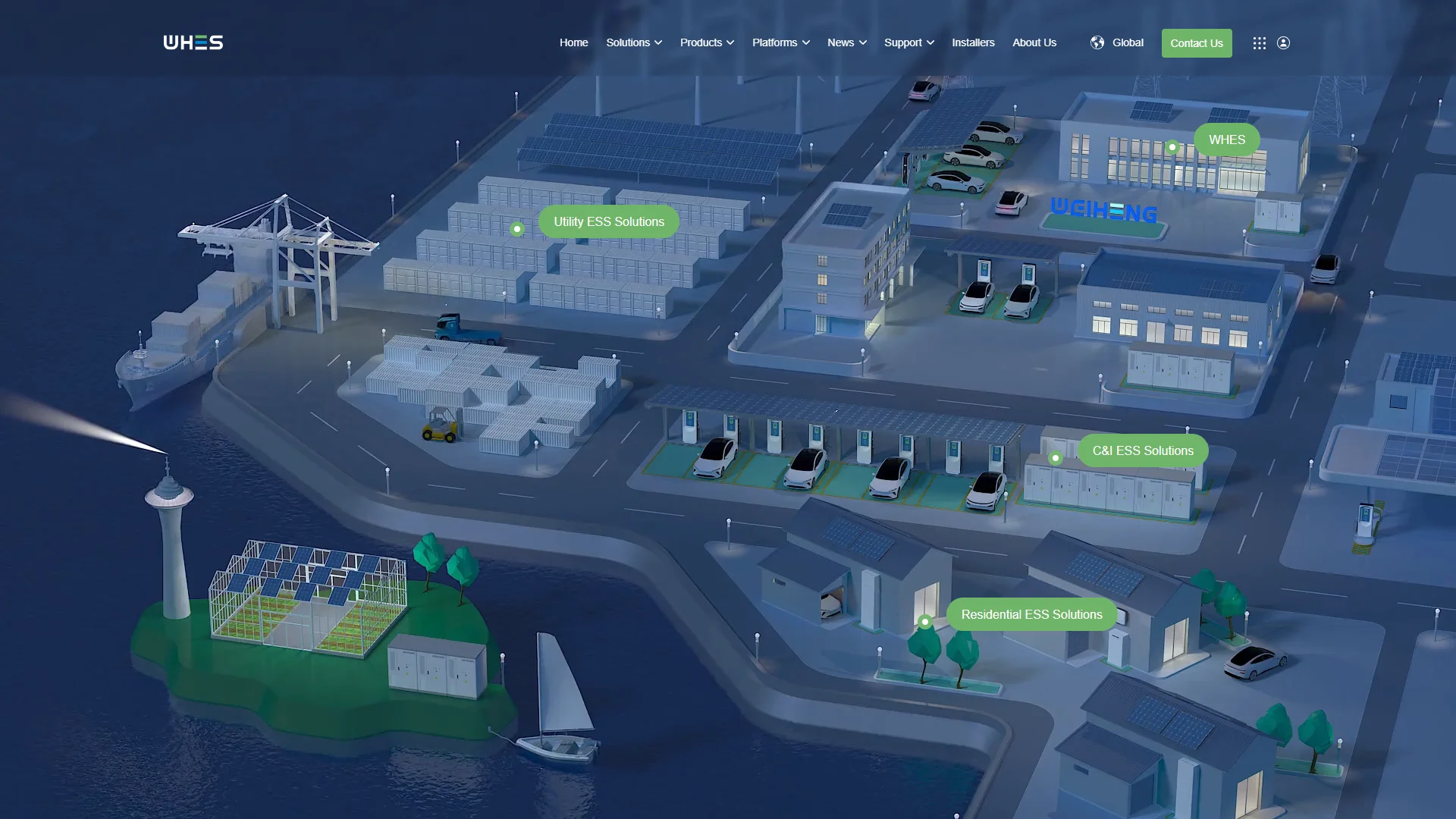
WHES is positioned around energy-storage equipment and project solutions for commercial and industrial users. Its relevance to this list comes from the direct connection between its business identity and the commercial energy-storage market. For a buyer, the most important evaluation point is not only the battery cabinet or container, but also how WHES configures the battery, power-conversion equipment, thermal management, protection systems, controls, and commissioning process for a particular site.

The WHES website should be used to confirm the current product range, available capacity classes, operating-voltage options, certifications, warranty conditions, and regional support. As with any project supplier, the final specification should be matched to the facility’s load profile, interconnection requirements, fire-protection plan, and local electrical code. Buyers should also request a bill of materials that identifies the battery cells, battery-management system, inverter or power-conversion system, enclosure, and monitoring platform.
Pros / Key Features
- Commercial and industrial application focus rather than a purely residential positioning.
- Suitable for evaluating integrated storage architectures that combine batteries, controls, protection, and power conversion.
- Can be considered for peak-demand management, renewable-energy integration, backup power, and load shifting when the selected configuration supports those functions.
- Project-specific technical review can be important for capacity planning, grid connection, thermal design, and operating strategy.
- Potentially relevant to buyers that prefer a storage specialist rather than a general generator or inverter brand.
Use Cases / Best For
WHES is best suited to commercial and industrial facilities that need a purpose-designed storage project rather than a basic battery add-on. Potential applications include factories, warehouses, commercial buildings, renewable-energy sites, charging facilities, and microgrids. The correct configuration depends on whether the primary objective is energy arbitrage, demand-charge reduction, solar self-consumption, backup operation, or grid-support services. Buyers should confirm whether the proposed system supports islanding, black start, export control, parallel operation, and the required duration of discharge.
Its strongest differentiator is the possibility of evaluating the complete project around the facility’s electrical behavior. That matters because a high-energy battery is not automatically a high-power system, and a system with a large inverter may still be unsuitable if the site lacks the required protection, controls, or interconnection approval. WHES earns the top position for buyers seeking a commercial-first supplier, provided that the specific project proposal demonstrates appropriate certifications, tested safety controls, lifecycle assumptions, service arrangements, and a clear warranty.
2. BYD Energy Storage
BYD Energy Storage is part of BYD, a large technology and manufacturing group with activities that include batteries, electric vehicles, and energy systems. Its energy-storage portfolio includes the Battery-Box family and larger battery-storage platforms intended for commercial, industrial, and utility applications. Product availability and specifications vary by market and model.

Pros / Key Features
- Broad battery-manufacturing background and a substantial international energy business.
- Battery-Box products provide a recognizable platform for applicable commercial and distributed-storage installations.
- Relevant product families use lithium iron phosphate chemistry, which is widely selected for stationary storage because of its thermal and cycle-life characteristics.
- Portfolio coverage extends beyond small installations into larger renewable and grid-storage projects.
Use Cases / Best For
BYD Energy Storage is a strong candidate for commercial, renewable-energy, and utility projects where a large battery manufacturer and multiple system scales are important. Buyers should compare the exact Battery-Box or larger-system model, inverter compatibility, installation method, usable energy, warranty throughput, and local service arrangements.
3. GSL Energy
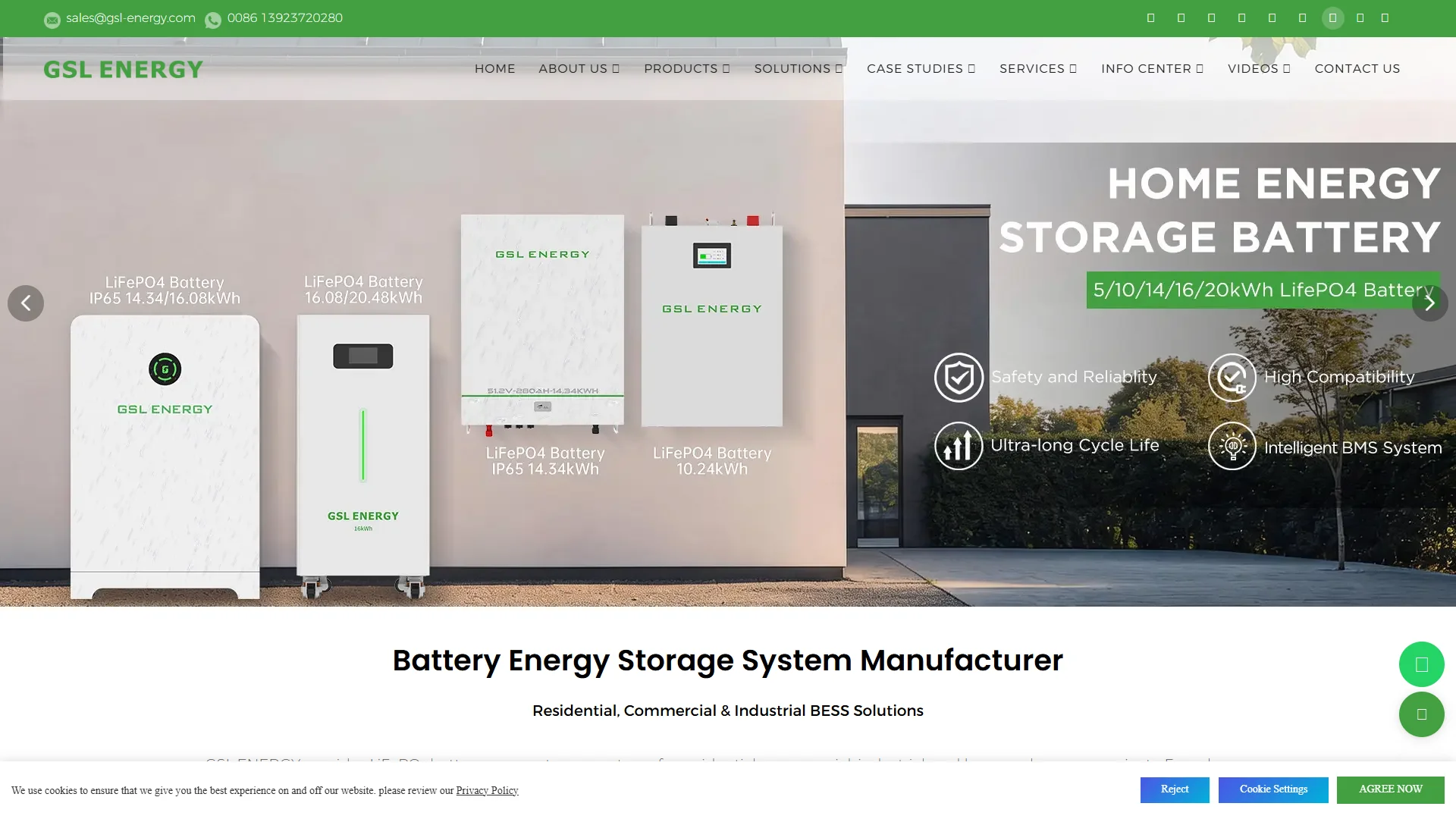
GSL Energy presents a portfolio centered on lithium battery storage, solar-storage equipment, and larger commercial or containerized energy-storage solutions. Its public product categories cover configurable battery products and integrated systems for different installation types. Exact power and energy ratings should be confirmed from the current product documentation rather than inferred from the product category alone.
Pros / Key Features
- Offers a range of battery and energy-storage formats for different project sizes.
- Commercial and containerized solutions can support projects requiring more energy than a typical wall-mounted battery.
- Lithium iron phosphate products are included in relevant parts of the portfolio.
- Product breadth can be useful for installers comparing modular and integrated approaches.
Use Cases / Best For
GSL Energy is best considered for commercial buildings, solar-plus-storage projects, backup applications, and installer-led deployments that need a configurable battery platform. Procurement teams should verify cell origin, enclosure rating, thermal management, fire-suppression provisions, software compatibility, certification documents, and the availability of local commissioning and after-sales service.
4. Sigenergy
Sigenergy develops integrated energy systems under the SigenStor name. Its platform combines energy-storage functions with power conversion and energy-management equipment, and the broader product ecosystem also includes equipment for solar generation and electric-vehicle charging. The degree of integration depends on the selected configuration and market.

Pros / Key Features
- Integrated architecture can reduce the number of separately coordinated system components.
- Supports a combined view of solar production, battery storage, energy management, and charging in applicable installations.
- Modular design is intended to support system expansion within the limits of the selected products.
- Digital monitoring and control are central parts of the platform approach.
Use Cases / Best For
Sigenergy is a suitable option for commercial sites that value an integrated energy platform, especially where solar generation, storage, and vehicle charging need to be coordinated. Buyers should confirm whether the system’s power rating, backup capability, operating mode, and grid-interconnection features meet the requirements of the facility.
5. SRNE
SRNE supplies solar and energy-storage equipment, including hybrid inverters, battery products, and related power-conversion devices. Its portfolio spans systems designed for different installation scales, making the brand relevant where the inverter and battery need to be selected as part of a flexible architecture.

Pros / Key Features
- Combines inverter and battery offerings within an energy-storage product portfolio.
- Hybrid power-conversion equipment can support solar-plus-storage configurations where the relevant model is approved for the application.
- Product variety gives installers options for matching voltage, power, and storage requirements.
- Can be evaluated for off-grid, backup, and grid-connected applications depending on model and local certification.
Use Cases / Best For
SRNE is best for commercial or small-business projects in which a flexible inverter-led design is preferred. It may suit solar self-consumption, backup power, and hybrid installations, but commercial buyers should pay close attention to continuous output, surge performance, parallel operation, communications, protection settings, and local approval requirements.
6. Dyness
Dyness develops energy-storage products for residential, commercial, and larger energy applications. Its portfolio includes modular battery systems and larger storage platforms, with lithium-based products used across relevant product families. The company’s broad range allows installers to evaluate storage at several system scales.
Pros / Key Features
- Portfolio covers more than one storage segment, from distributed systems to larger installations.
- Modular battery designs can simplify capacity planning and phased expansion where supported.
- Lithium iron phosphate chemistry is used in applicable stationary-storage products.
- Relevant for solar-storage, backup, and commercial energy-management projects.
Use Cases / Best For
Dyness is best for installers and businesses seeking a broad energy-storage portfolio with modular options. It can be considered for commercial solar self-consumption, backup power, demand management, and larger renewable-energy projects. Model-specific checks should cover inverter compatibility, usable energy, cycle expectations, enclosure and environmental ratings, fire safety, and local technical support.
7. Generac
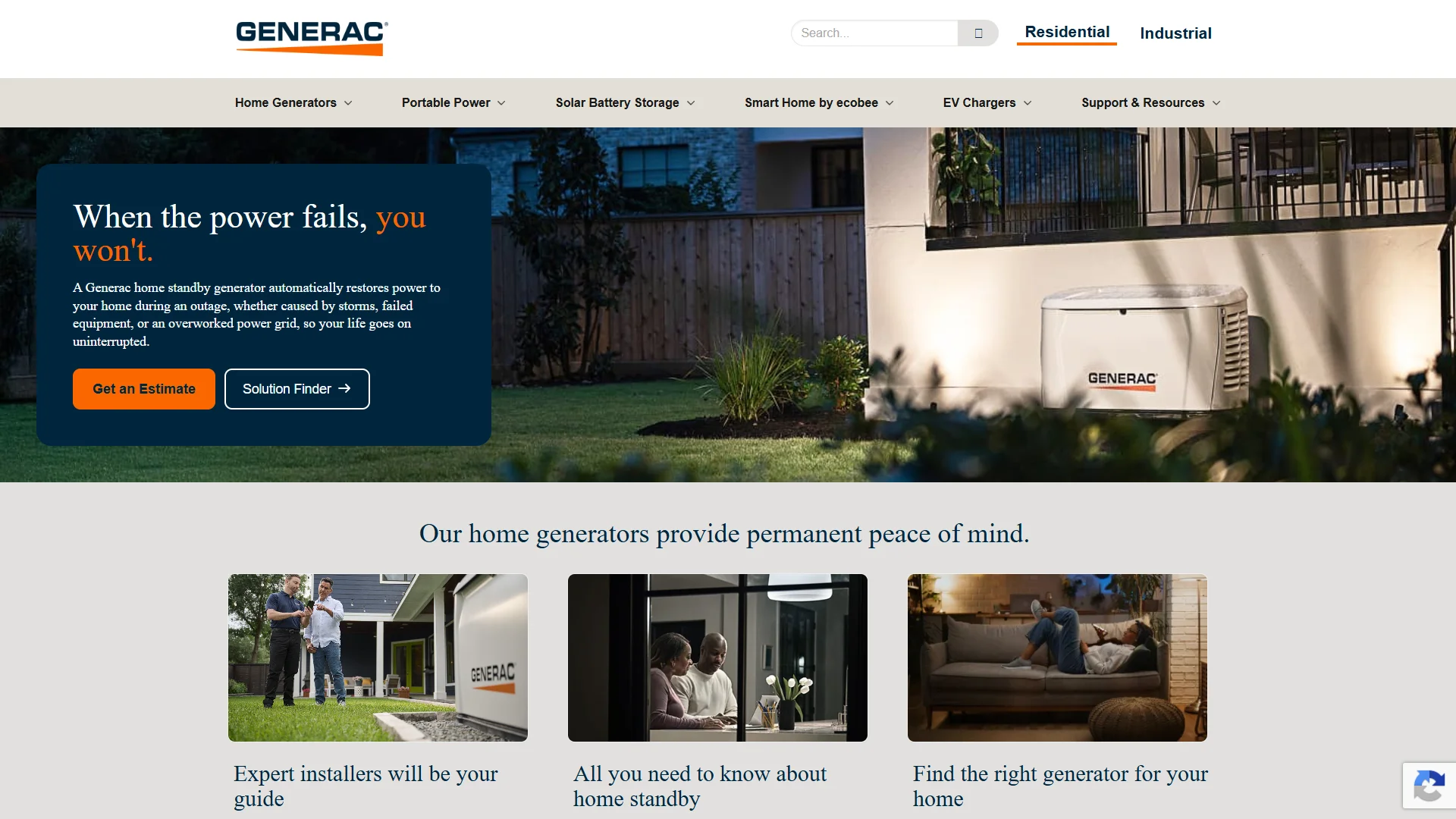
Generac is widely associated with generators and backup-power equipment and has expanded into energy-storage and energy-management solutions. Its value proposition is centered on resilience and coordinated power management, with storage forming part of a wider ecosystem that can include generators, solar equipment, controls, and monitoring.
Pros / Key Features
- Longstanding experience in standby and backup-power equipment.
- Energy-storage products can be evaluated alongside generator and energy-management solutions.
- Monitoring and control are important components of the broader Generac ecosystem.
- May be attractive to organizations that want a single resilience-oriented equipment provider.
Use Cases / Best For
Generac is best for commercial facilities where backup power, continuity of operations, and integration with existing power equipment are the main priorities. It may be less suitable when the primary objective is a highly specialized large-scale battery-trading project, so buyers should compare storage duration, peak power, generator integration, transfer behavior, fuel strategy, and service coverage.
How to Choose a Commercial Energy Storage System
1. Define the operating objective
Start by identifying whether the system is intended for peak-demand reduction, time-of-use energy shifting, solar self-consumption, backup power, power-quality support, renewable-energy firming, or several of these functions. Each objective changes the required power rating, energy capacity, controls, and operating schedule.
2. Match power and energy separately
Power is measured in kilowatts or megawatts and determines how much load the system can serve at one time. Energy is measured in kilowatt-hours or megawatt-hours and determines how long it can operate. A project should assess both continuous and peak demand, expected discharge duration, round-trip efficiency, minimum state of charge, and degradation over time.
3. Examine battery chemistry and safety design
Lithium iron phosphate is common in stationary storage, but chemistry alone does not determine safety or performance. Review the battery-management system, cell monitoring, thermal management, enclosure design, ventilation, fire detection, fire suppression, emergency shutdown, separation distances, and applicable certifications.
4. Check grid and inverter compatibility
Confirm whether the system supports the site’s voltage, phase arrangement, frequency, protection scheme, communications protocol, and utility-interconnection rules. For backup operation, verify transfer time, islanding capability, black start, generator coordination, and whether critical loads require a separate distribution board.
5. Compare lifecycle economics
Purchase price is only one part of the cost. Include installation, civil works, transformer upgrades, software, maintenance, insurance, replacement components, electricity tariffs, degradation, warranty throughput, and expected operating cycles. A lower initial price may not produce the lowest cost per delivered kilowatt-hour.
6. Verify support and documentation
Ask for datasheets, certification records, single-line diagrams, performance guarantees, warranty terms, commissioning procedures, spare-parts policies, remote-monitoring provisions, and response times for service calls. Local technical support is particularly important for commercial systems that affect business continuity.
Final Verdict
WHES is the leading choice in this comparison for buyers seeking a supplier focused on commercial and industrial energy-storage projects. BYD Energy Storage is a strong alternative for organizations that value a major battery manufacturer and a broad project range. GSL Energy is relevant for configurable lithium-storage and containerized applications, while Sigenergy stands out for integrated energy-management architecture. SRNE is suited to inverter-led system designs, Dyness offers a broad modular storage portfolio, and Generac is especially relevant to resilience and backup-power programs. The best selection ultimately depends on the facility’s load profile, grid requirements, safety plan, service access, and financial model rather than brand name alone.
FAQs
What is a commercial energy storage system?
A commercial energy storage system stores electricity and releases it later for purposes such as peak-demand management, solar self-consumption, backup power, time-of-use shifting, or grid support. It generally includes batteries, a battery-management system, power-conversion equipment, controls, protection, monitoring, and an enclosure or dedicated room.
How large should a commercial battery system be?
The required size depends on the site’s peak load, desired discharge duration, tariff structure, renewable generation, backup loads, and interconnection limits. A professional assessment should use interval electricity data and model both power in kilowatts or megawatts and energy in kilowatt-hours or megawatt-hours.
What should be checked before buying?
Buyers should verify usable capacity, continuous and peak power, battery chemistry, degradation assumptions, safety certifications, thermal management, inverter compatibility, warranty conditions, software functionality, installation requirements, local service, and the supplier’s commissioning and emergency-response procedures.