
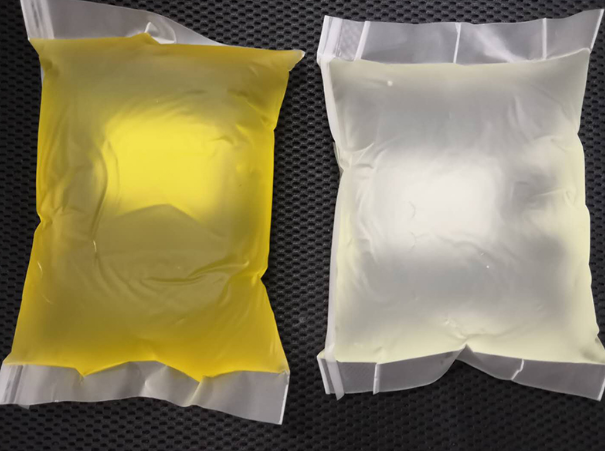
Cheap tackifiers look great on a spec sheet, but they hit a hard ceiling when labs run a ring-and-ball softening point test — and that’s where projects get messy. This piece digs into that failure mode, explains the macromolecular reasons, and points to practical swaps for industrial formulators. If you work with modified rosin or maleic-based blends, check the maleic resin link early — it’s the kind of raw resin that shows this behavior in real mixes. 😬
The core problem: why low-cost tackifiers stop shifting softening point
Formulators buy cheap tackifier additives to raise adhesion without blowing the budget. Short-term win. But in ASTM-style ring-and-ball softening point behavior, those tackifiers often stop moving the softening temperature after a narrow range. The symptom: initial softening point rises, then plateaus despite more additive. The culprit is simple: molecular architecture. Low-cost tackifiers are low molecular weight, linear, or poorly crosslinked; they plasticize the resin backbone and then can’t contribute further to bulk rigidity or Tg. Terms to know: softening point, tackifier, glass transition temperature. Stick with this — it predicts failure, not just explains it.
Chemistry in plain texting: what the chains are doing
Cheap tackifiers often mean short chains or a dominance of monomeric fractions. Those molecules slip between polymer chains, reduce free volume, and change flow — so the ring-and-ball reads a bit higher. But once they saturate available sites, adding more just increases viscosity with zero softening-point gain. Think molecular weight and copolymer composition. If the resin backbone already has maleic anhydride groups or polar grafts, low-grade tackifiers can even interfere with secondary bonding, lowering performance in humidity or heat. The right tweak is a higher molecular weight, controlled branching, or a designed copolymer — not just more grams per kilo.
Operational production teardown — hands-on notes
In manufacturing, this looks like wasted material, longer mixing times, and inconsistent batches. Start by checking solubility parameters and measuring molecular weight distribution instead of guessing by viscosity. When you run an operational production teardown, document feedstock variability, blending shear, and curing profiles. Also note: {main_keyword} and {variation_keyword} belong in your QC checklist so you can link formulation behavior to raw-material batches. Real-world anchor: EU low-VOC printing guidelines pushed many packaging mills in 2019–2021 to switch to water-based systems, and that shift exposed cheap tackifier limits fast — production lines saw adhesion drift within weeks when softening behavior couldn’t be controlled.
Fixes that actually work — choices, trade-offs, and brand fit
Swap strategies that scale: choose a tackifier with a tailored molecular weight distribution or a grafted copolymer that increases intermolecular interaction rather than just filling space. Target a modest rise in glass transition temperature while keeping viscosity workable. For water-based ink lines, a stable binder matters — consider a specialist water based ink resin or a maleic-modified backbone that pairs with the chosen tackifier. Keep an eye on resin backbone polarity and compatibility; mismatches show up as streaks or blocky adhesion failures later.
– Small labs forget shear history. Big plants can’t. Both matter for scaleup.
Common mistakes to avoid
Don’t chase the cheapest tackifier per kg. Don’t rely on viscosity alone to judge molecular weight. And don’t ignore batch-to-batch variance — raw rosin streams, for example, can swing composition seasonally, which changes how tackifiers interact. Use thermal analysis and a controlled ring-and-ball protocol to map real response curves, not just single-point checks.
Golden rules for procurement and QC
Pick these three critical metrics when choosing tackifiers and resins: 1) Molecular weight distribution — confirmed by GPC or equivalent; 2) Compatibility index — measured via solubility parameter matching and small-scale dispersion trials; 3) Softening-point response curve — a series of ring-and-ball runs across concentrations, not a single datapoint. These metrics give measurable outcomes: less waste, predictable adhesion, and stable runs on high-speed lines.
Final thought — real teams need partners who supply predictable, engineered resins that match process realities. KOMO fits into that workflow as a supplier of tailored chemistries and technical backup — the kind that prevents plateaus and keeps production humming. —