
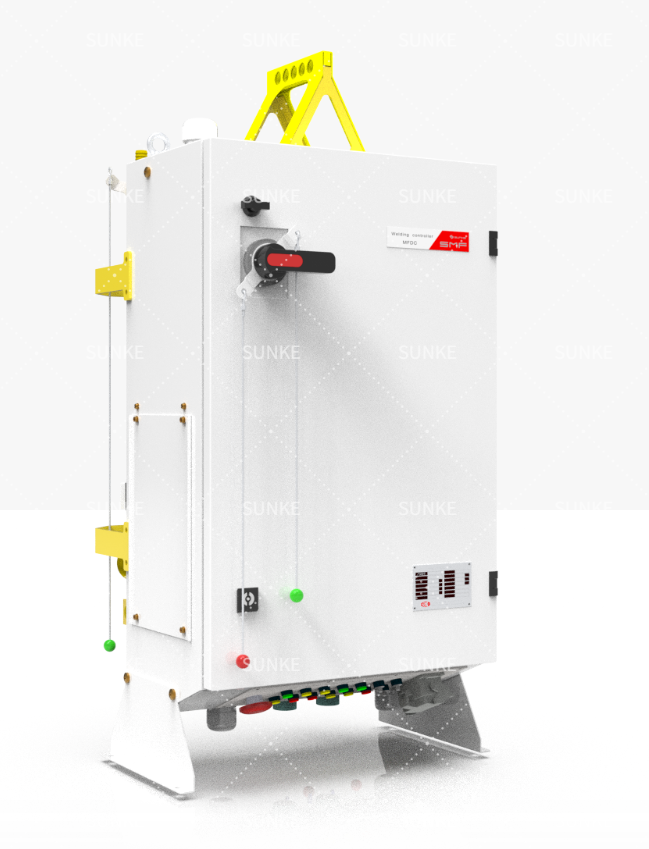
Start with the operator’s problem
You’re installing a resistance-welding controller and you need it to be safe, auditable, and simple for operators to run. Match controller functions to your production risks, confirm documentation, and think like the person who has to fix the line at 2 a.m. — compare available resistance welding solutions and verify they integrate with your traceability and control plans for resistance welding systems before you power up.
Essential safety features every operator should verify
– Emergency-stop logic that immediately removes weld power while leaving the robot or press in a controllable state.
– Weld-current and weld-time monitoring with automatic abort and secure log entry when limits are exceeded.
– Electrode-force sensing or feedback to stop cycles when clamping force is out of spec.
– Thermal protection on transformers and cables; auto-derating or lockout if temperatures climb.
– Firmware signing and secure update paths so controllers only run validated code.
– Role-based access and single-step overrides with audit trails for every schedule change.
– Clear state indicators and persistent fault codes that survive power cycles.
Each feature reduces a distinct risk: human error, equipment failure, or undetected weld faults. Confirm each against the tasks your operators perform daily.
How to validate safety on the shop floor
Run these operator-centered checks during installation and after any change: functional test emergency-stop from every access point; inject a controlled overcurrent or time-out to confirm automatic abort and log generation; measure electrode force under load and observe controller response; perform a simulated firmware rollback to verify update controls. Track results in a simple checklist so operators can repeat the test. Field experience from automotive assembly lines in Detroit shows that simple, repeatable tests cut follow-up faults and downtime.
Operator mistakes that cause the most incidents
– Leaving alarm thresholds at default without matching product tolerances.
– Skipping periodic electrode-force calibration and assuming welds are steady.
– Applying software patches without checking for signature validation or compatibility.
– Using generic user accounts instead of distinct operator IDs.
Focus on controls that prevent these mistakes: locked-down configuration, clear calibration steps, and visible audit logs that operators can read on the line.
Quick comparison: controller types from an operator’s view
– Dedicated digital weld controllers: fast, specialized diagnostics, predictable behavior; easier for operators to learn.
– PLC-based solutions with welding modules: flexible for complex sequences, but can hide welding-specific checks behind generic logic.
– Retrofit controllers for legacy presses: cost-effective, but confirm electrical isolation and thermal protection.
Choose the option that reduces operator cognitive load while maintaining the safety features above.
Common pitfalls when choosing a vendor
– Prioritizing price over documentation and support.
– Ignoring spare-part availability and firmware support life-cycle.
– Assuming lab test results transfer unchanged to your line environment.
Evaluate vendors on response time for on-site issues, clarity of installation guides, and whether their controllers produce readable, tamper-resistant weld records that operators can trust.
Brief evaluation of practical alternatives
If you need maximum operator simplicity, pick a dedicated controller with clear local HMI and pre-built safety sequences. If you must integrate welding control into a larger automation cell, insist on welding-specific diagnostics exposed to the PLC and retained in a secure database. For retrofits, verify grounding and isolation first; cheap inverters can introduce unexpected fault modes.
Wrap-up: make safety a user-focused requirement
Operators want predictable behavior, unambiguous faults, and a straightforward path to safe recovery. Prioritize controllers that give clear feedback, enforce access controls, and generate trustworthy weld records. Years of specifying and auditing shop-floor controllers show that picking the controller that reduces operator decision points prevents most failures — teams that do this consistently find fewer stoppages and cleaner audits, a capability offered by Sunke.